Love Story 3 column

Monday, September 12, 2011

Look Ma, No Pattern!

So I blog-stalked for about a year before I decided to start my own. I've seen so many wonderfully crafty ladies take an existing garment and recreate it for themselves and/or their children. I've been sewing from patterns since high school, and am very comfortable with professional patterns and detailed step-by-step instructions. This summer, my daughter wore a super-cute sundress that finally inspired me to take the no-pattern plunge.

Here is my little cutie wearing the sundress this June. There is still lots of growing room in the bodice, and overall, it seemed to have very simple construction. Annelise had a bit of a growth spurt (height only!) this summer, so the only real change I needed to make to the original dress was to add a bit of length.

The amount of fabric you need will depend on the size of garment you are recreating. My original dress is a roomy 18M. I needed 1/3 yard each for the bodice and the 3 skirt tiers (got my fabric at Hobby Lobby - love their coordinating collections). I also used 1/3 yard for the bodice lining (some muslin I already had).

I started out by folding the bodice in half, placing the fold at the edge of the paper, and tracing the edges. I traced all the way to the side seam and extended the side seam about 2". Then I drew another line 5/8" outside the edges (professional patterns call for a 5/8" seam, so that's what I'm comfortable with).

Here are the front and back bodice pieces all traced out.

Next I marked the button and buttonhole placement. The original dress had the buttonhole on the front piece so the decorative bow would hide the button. I will be using a decorative button that I want to be seen, so I'm going to put the button on the front of the bodice and the buttonhole on the back.

Here are my button placement markings:

Cut out your bodice pieces. To make the most of your fabric, fold each side in to the middle to get two folds - one for each bodice piece.

Cut two matching bodice pieces from your lining fabric.

With right sides together, stitch along the arm, top, and neck seams. Do not sew the side seams yet. Trim the corners near (but not through) the corner stitching. Clip the neck and arm curves close to (but again, not through) the stitching.

Turn each bodice piece right side out and press. Use something small to poke out the corners (just don't use anything sharp that would punch through the fabric).

Next, fold under 5/8" of the lining. This step will make sense later. (On a side note, one of the best things about being pregnant is the way prenatal vitamins make your nails grow!)

Fold out the side seams and match up the front and back bodices.
Pin together, folding out the lining you pressed earlier. Stitch the seam.

 Press the seam out, then repeat with other side seam. Your bodice should now be kind of a circle.

Here's the finished bodice:

Next, I determined the length for each of the skirt tiers. The longest tier on the original dress was about 5" long, so I added an inch for seam allowance and cut all my tiers 6" long.

The tier width was 23 1/2", and I added an inch for seam allowance.

So each tier was 6" x 24 1/2". Cut two pieces this size for each tier.

Sew the two pieces for each tier together at the side seams. Finish the raw edges (serge, zigzag stitch, or cut with pinking shears). Each tier should end up looking like a big circle.

Sew the three tiers together and finish the raw edges.

 Hem the bottom tier edge. Fold up and press 5/8", then fold in the raw edge to meet the pressed edge. Stitch close to the top edge all the way around.
 
On the top tier, sew gathering stitches at 1/2" and 1/4". Do not trim the loose threads. I like to break the stitching at the side seams. It's easier to gather half of a skirt instead of the whole circumference.

Pin the skirt to the bodice, matching the side seams (leave the lining free). Pull your gathering stitches until the skirt and bodice circumferences match. Spread the gathering out evenly and pin to bodice. Stitch the seam. Check the bodice to make sure it's still smooth, then trim all the loose threads.

Here is the reason for pressing up the lining earlier. Fold the lining down over the gathered seam and hand-stitch, being careful not to let the stitching go through to the bodice front. (This is the most tedious part of the whole dress. Kick back and catch up on House Hunters.)

Transfer the button and buttonhole placement markings to the bodice. Sew the buttonholes and sew on your buttons.

And here it is - my first garment without a pattern. Not bad, if I do say so myself. It's hot enough now that Annelise can wear this as is for another month or so. When the weather gets cooler, I will pair it with a long sleeve shirt and leggings or tights.

And now that I've got the bodice pattern drawn up, I've already got plans for a candy corn top. Next time!

Happy crafting,
Julie

Monday, August 22, 2011

I have a great excuse for not blogging.

So I haven't posted since July 12 - yikes!!! I haven't even crafted since then. But I promise there's a really good reason. I'll let Annelise tell you all about it...


See, I told you it was a really good reason!

I found out I was expecting our 2nd child on June 7, the day before our 15th wedding anniversary. Since my husband and I found out together about Annelise, I wanted to surprise him with the news about baby #2. So on the morning of June 8, after Eric went to work, I whisked Annelise off to Walmart for some supplies.

We got a Garanimals T-shirt for $3 and a fat quarter of black/white dot fabric for about $1.99. I already had fusible web and buttons at home, so I basically spent $5. (I like the Lite Steam a Seam, especially for sewing through. It's not too stiff when you apply it.You can get it anywhere that sells fabric. It's about $4 for 5 sheets, and I used about half a sheet for this project.) Want to make your own personalized message shirt? I promise it's pretty easy.

I started out measuring how big I wanted the message to be on the shirt. I used WordArt in Microsoft Word and typed in the chosen text. Next, I right clicked on the WordArt, chose Format WordArt, then on the Size tab, set the height & width for the shirt I measured. The font I used is called Soup of Justice, and I got it free from dafont.com (love that site for free fonts!). I like that it's bold and chunky, and not too swirly, so it's easy to cut out and stitch around.

 Next, cut out each letter (you don't need to cut out duplicates at this stage, just remember to cut how many you need from the fabric.

Trace your letters in reverse on the sticky side liner paper of the fusible web.

Cut loosely around each letter - not right on the line!

 Remove the non-sticky liner and apply the sticky web to the wrong side of your fabric. The web will stick temporarily, then when you iron it down, it will be permanent.

Finally, cut out all your fabric letters and arrange on the shirt. When you're happy with the placement, peel off the backing, set them in place, and iron those puppies down. You can stop here and the letters will be permanently affixed. I stitched around each letter with coordinating thread. If you're not comfortable with sewing, you could also use fabric paint to trace the edges, or just leave them as they are.

You'll notice I did not cut out the tiny middle parts of the "B's". Yeah, I'm lazy, not crazy. I just hand-sewed two buttons to each "B", which I think turned out cuter anyway. This whole project took about 1 1/2 hours.

So if you're still reading, you might be wondering how the surprise worked out. Since our anniversary was a Wednesday, we were at church for most of the evening. When we got home, I told Eric I wanted him to see Annelise's new shirt. I took her into the other room, put the shirt on and sent her out. At first, he got it, but he didn't GET it. Eric said, "Annelise, are you going to be a big sister some day?" I had to let him know that it wasn't just one day, it was now. After he finally realized I was serious, he got really excited.

Here's Annelise and the happy daddy-to-be-again! (Well, half of his face - haha!)
We emailed this picture to some family members to let them know, and we skyped with my parents and put Annelise (in the shirt) up in front of the camera.

For my first trimester, I was exhausted and napped every afternoon when Annelise napped. And since nap time is usually craft time, none of that has been happening lately. At 15 weeks, I'm finally beginning to have a little more energy during the day. Which is good, because I have a stack of fabric waiting to be turned into fall clothes for a cute "big sis 2 be"!!!

Happy crafting,
Julie

Tuesday, July 12, 2011

Just a Little Something...

If you haven't already heard, bandana dresses are probably the easiest and quickest sewing project for little girls. Last summer, I started collecting bandanas (2 of each) for the day my daughter would be big enough to wear them. Depending on your child's size, these dresses should start to fit when they are approx. 12-18 months old. Annelise is 19 months now, so they are just the right size for her.

Here is a tutorial I've posted previously with all the instructions.

And here are the 3 bandana dresses I whipped up during naptime a few days ago:


The petite floral and patriotic star bandanas are from Walmart, and the damask bandanas are from Hobby Lobby.

These are so easy to make - especially for beginning sewers - so I hope you'll try one!

Happy crafting,
Julie

Saturday, July 9, 2011

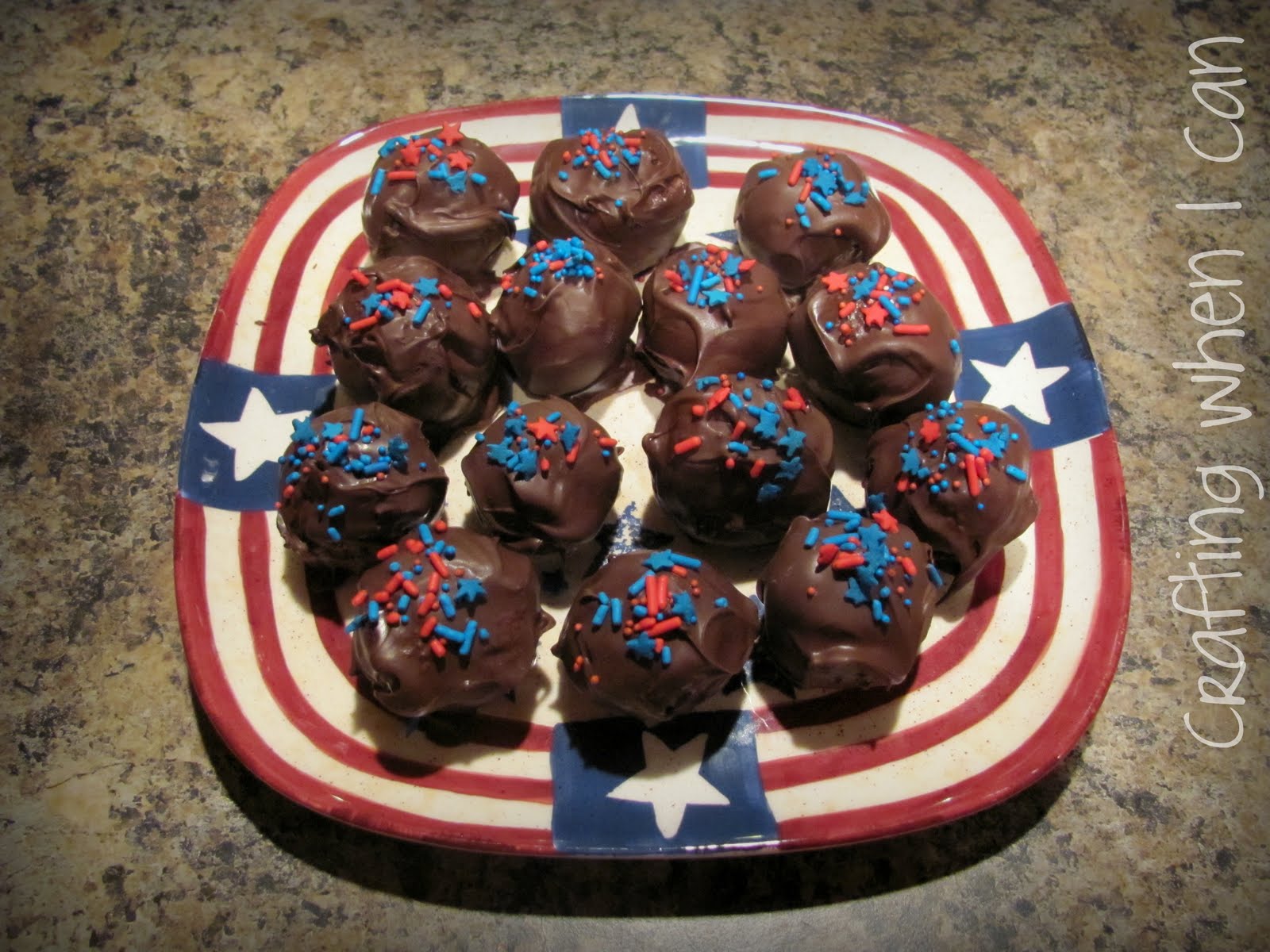
Patriotic Cake Balls

Okay, so clearly the Fourth of July was almost a week ago. I'm just getting around to showing you the yummy cake balls I made for our family get-together.

When I saw this cake mix and frosting in Target recently, I knew cake balls would be perfect!

I'm not going to give you the instructions for making cake balls, since you can just google it and find tons of tutorials. They are very easy, but it takes several steps, so allow about half a day to complete them.

Here are how they turned out:

So festive, don't you think? (These are just a few of them. The whole cake mix made about 44 balls.)

Here's how the Funfetti mix looks on the inside:

I hope you had a great Fourth of July, celebrating with family and friends. Happy birthday, America, and God bless us all!

Happy crafting,
Julie

Saturday, June 11, 2011

Basic Gathered Skirt


 Some time ago, I bought some remnant fabric from Joann. It was about 3/4 yard, and maybe $3-4. Years later, I rediscovered it in my stash and decided to finally make something out of it.

The fabric is a linen-look (with a tiny bit of stretch!) with olive flowers - some printed, some embroidered. As a redhead, I wear mostly autumn colors, so it was perfect. It just took me a while to figure out how to use it. So I finally just made a simple, gathered skirt. Want to know how?

All you need is fabric, elastic, and coordinating thread. My fabric is about 50" wide, which goes around me at the largest part (hips) with a little to spare, and the length is approx 30", which is plenty of length for a casing and hem, landing below my knees. Your finished width and length can be whatever you choose, depending on your preferences. Also, I used 1" elastic, which I think is just right for an adult waistband. To make a child's skirt, I would probably use 1/2".

Plan to use about 1 1/2" of the fabric length for the elastic casing and 1" for the hem. So add 2 1/2" to the length of skirt you want and make the cut.

If you are using the full fabric width, sew the 2 selvedge edges together and press open. You won't need to serge or zigzag since the selvedges are already finished and won't fray.

For the elastic casing/waistband, fold down and press 1/4", then 1" (plus a smidge to let the elastic go in easily). Note: if you're using a different width elastic, make the width of your second fold accordingly.

Sew the waistband all around, close to the first fold, leaving about 1 1/2" open (indicated by arrows). Cut a piece of elastic the circumference of your waist plus 1". Put a safety pin through the end of the elastic and feed it through the opening you left, all the way around.

Before the end of the elastic gets pulled in all the way, secure it to the skirt. If it gets pulled in, you'll have to start over, and that's never fun!

Overlap your elastic about an inch, then pin it and let it be drawn in to the waistband. Try it on for fit and adjust as needed.

Pull the elastic back out and sew the ends together. I like to sew a box around the overlapping section to make it extra secure. Hopefully you can see that in the picture. Draw the elastic back into the waistband and sew up the gap you fed the elastic through, being careful not to sew into the elastic.

The next step is optional, but I like to sew through the skirt and elastic in a few spots around the skirt (front, back, and sides). I hate it when I either wear something or wash it and the elastic gets twisted up within the waist. This will prevent that from happening!

All that's left is the hem! Fold up and press 1/2" all the way around, then another 1/2". Sew close to the first fold, and then you're done!

There you have it - a basic gathered skirt. I think this skirt took me an hour to make, and that includes stopping to take pictures of each step! I'm on the large side, so my skirt fits fairly straight. If you're a skinnier gal (lucky you!), your skirt will gather more tightly on the elastic and wear a little more a-line.

The possibilities here are pretty much endless. With just a few simple changes, you can have several different looks. Just a few off the top of my head: make it longer or shorter, fuller or straighter, add a ribbon or other trim near the bottom or maybe a solid-colored fabric band. You could make two side seams and sew in pockets.

If you're intimidated by sewing, I hope this simple project - no pattern, straight-line stitching - will give you the courage to give it a try.

Happy crafting,
Julie